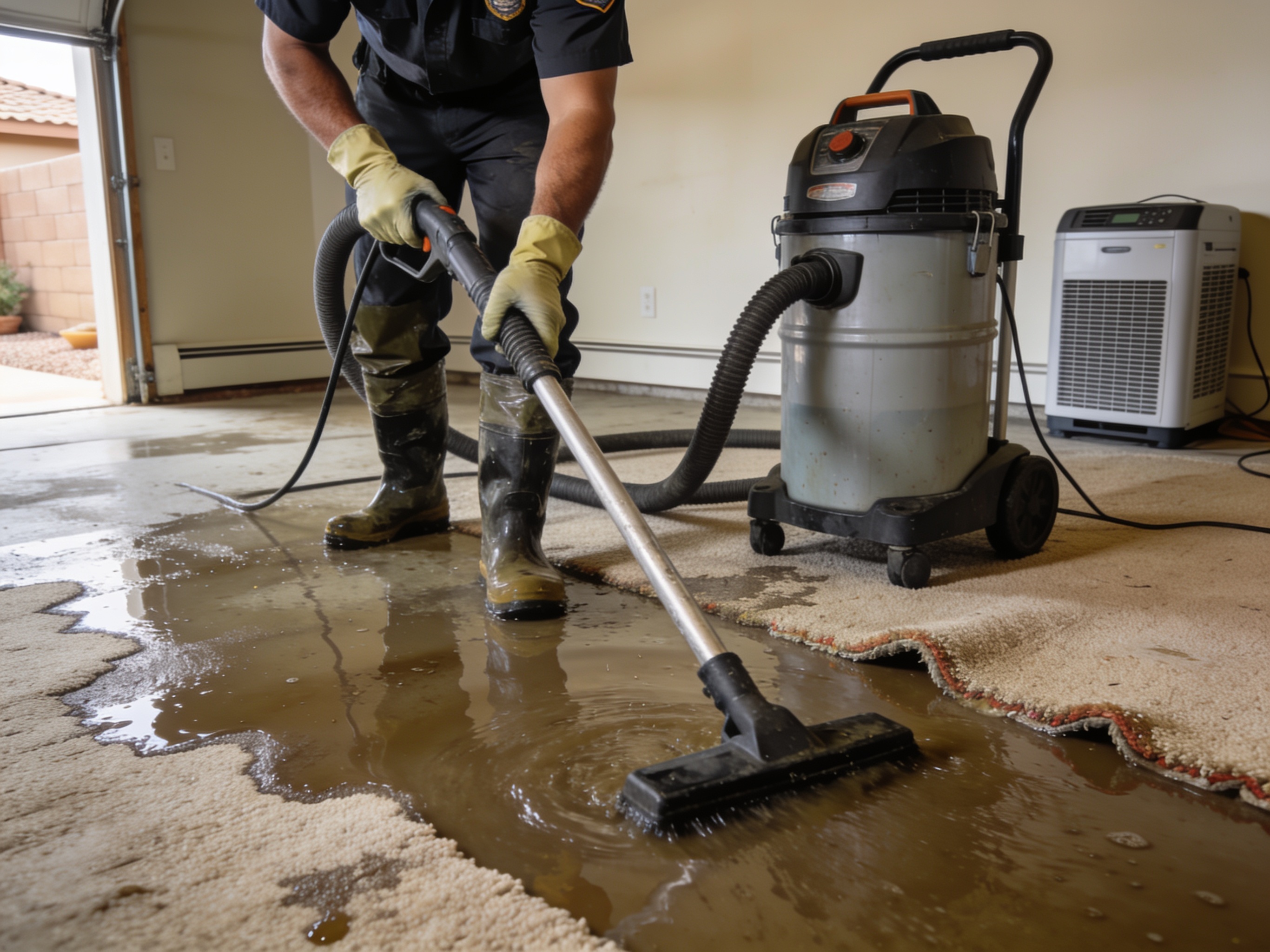
Mesa’s older housing stock in Downtown Mesa and along Main Street often sits on concrete slabs poured directly on grade. When water enters from a supply line or appliance, it travels laterally under the slab and into the red clay soils common in Maricopa County. Emergency extraction must pull standing water and then address the film left between slab and vapor barrier before the 110-degree summer heat turns that film into trapped humidity that feeds mold within 48 hours.
Newer builds in Superstition Springs and near Riverview Park use post-tension slabs and stucco walls that can hide water for days. Technicians bring moisture meters and infrared cameras to locate migration paths that standard fans miss. Once water is removed, dehumidifiers sized for desert heat loads run continuously because ambient humidity spikes during monsoon events can re-wet drywall even after visible water is gone.
Nearby Phoenix and Tempe jobs show the same pattern: water from roof penetrations at the Superstition Mountains foothills travels down stucco and pools at the base plate. Extraction crews cut weep holes low on the wall and use negative air to pull moisture outward rather than pushing it deeper into insulation. This step prevents the need for full wall replacement that becomes common when homeowners wait until evening temperatures drop.
Work is performed from the address at 32 W Main St with crews available Mon–Fri 8am–6pm and Sat 9am–2pm so response reaches Red Mountain or Superstition Springs addresses before the next heat spike.
Technician insight
In Mesa, the thing that catches most people out with Emergency Water Removal is how fast water travels under post-tension slabs in Red Mountain homes once monsoon rain hits the Superstition Mountains foothills. Homeowners shut off the main valve but leave the film between slab and soil untouched, and the next 110-degree day turns that film into hidden humidity that ruins base plates.
Downtown Mesa Slab Migration
Water from a supply line leak in a 1970s home near Mesa Arts Center traveled under the slab into two bedrooms. Extraction crews mapped moisture 18 feet past the visible wet carpet, pulled standing water, then set negative air to draw remaining moisture from the clay subgrade before extreme afternoon heat could push it into framing.
Emergency Water Removal Services We Offer
✓Burst Pipe Water Extraction
Immediate pump-out and containment of pressurized water releases inside walls and under slabs common in Downtown Mesa homes.
✓Appliance Leak Removal
Targeted extraction from refrigerator, washer, or water heater failures before moisture reaches adjacent Red Mountain kitchens and laundry rooms.
✓Monsoon Flood Extraction
Rapid removal of stormwater that enters through doors and windows during summer monsoon events near Superstition Springs.
✓Sewage Backup Cleanup
Safe extraction and disposal of contaminated water from main-line backups that affect older gravity lines in central Mesa neighborhoods.
✓Roof Leak Water Removal
Extraction of rainwater that penetrates tile or flat roofs and travels down stucco into living spaces near Riverview Park.
Emergency Water Removal Cost in Mesa, AZ
| Service | Typical Range | What Affects It |
|---|---|---|
| Initial Extraction Visit | $250–$550 | Varies with square footage and water depth in slab homes |
| Additional Room Extraction | $150–$300 | Per room when water has migrated laterally |
| Monsoon Or Sewage Surcharge | $100–$200 | Added for contaminated water handling |
| Daily Equipment Monitoring | $75–$125 | Per day while extraction equipment remains on site |
Ranges are typical for Mesa, AZ and confirmed with an exact written quote before any work starts.
How it works
- 1
Arrival And Safety Shutdown
Crew reaches the property, locates the water source, and shuts off supply lines or power to affected zones.
- 2
Standing Water Extraction
Truck-mounted and portable pumps remove bulk water from floors, carpets, and cavities while containing runoff.
- 3
Hidden Moisture Mapping
Infrared and pin meters trace water migration under slabs and behind walls typical of Mesa construction.
- 4
Initial Drying Setup
Air movers and dehumidifiers sized for desert conditions begin pulling remaining moisture before heat drives it deeper.
Pricing
Cost depends on water volume, depth under slab, and number of affected rooms.